An outdoor natural gas tankless water heater delivers hot water on demand without a storage tank, helping save space while supporting multiple fixtures when correctly sized. Outdoor-rated units mount outside the home, vent directly to open air, and can be a practical option for warm-water comfort, efficiency, and simpler venting—provided freeze protection, gas supply, and installation details are handled correctly.
What an Outdoor Tankless Water Heater Does (and What Makes It “Outdoor”)
Tankless water heaters warm water only when a fixture or appliance calls for it. Instead of storing hot water in a tank, a natural gas burner heats a heat exchanger as flow begins, then modulates (ramps up or down) to maintain the set temperature as demand changes.
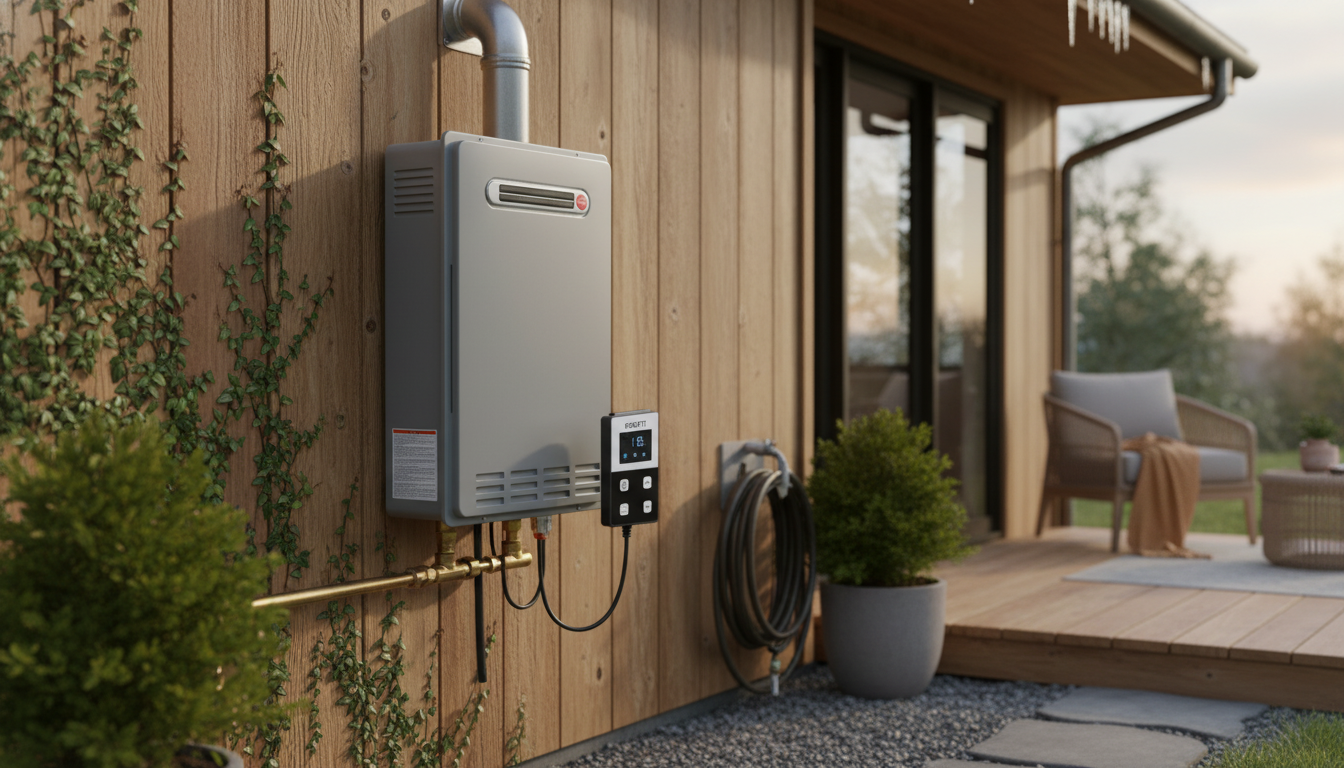
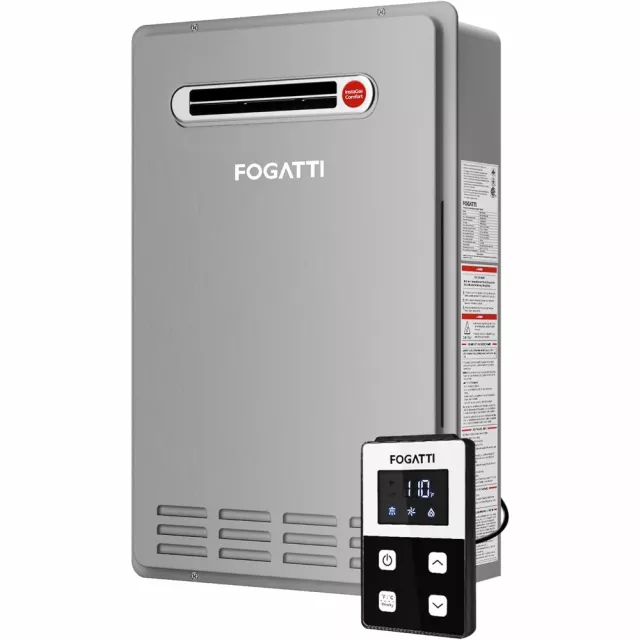
What makes an “outdoor” tankless model different is the cabinet design and exhaust approach. Outdoor units are built for exterior mounting and discharge combustion exhaust directly to open air, which can eliminate the need for long vent runs through attics, crawlspaces, or utility rooms. This can simplify layout and free up indoor mechanical space.
Common applications include whole-home domestic hot water, supplying a pool house/ADU, workshops, cabins, or any home where indoor installation is tight. The key trade-off is exposure: wind, rain, debris, and freezing temperatures can affect performance and reliability if placement and protection aren’t planned carefully.
At-a-Glance Specs to Confirm Before Buying
A tankless heater’s label specs look straightforward, but real performance depends on your water temperature, gas supply, and how your home actually uses hot water.
- Fuel type and conversion: Choose a natural gas model and confirm whether it supports conversion to propane (and whether a conversion kit is included).
- Maximum flow rate (GPM) at a temperature rise: Compare your coldest incoming water temperature to your desired setpoint to understand your true, not advertised, flow.
- BTU input range and modulation: A higher maximum BTU can support more simultaneous fixtures; good modulation helps avoid temperature hunting at low flow.
- Minimum activation flow: Important for low-flow faucets and some recirculation setups; if flow is below the threshold, the burner may not light consistently.
- Electrical requirements: Many outdoor units still need 120V power for ignition, controls, fans, and built-in freeze protection heaters.
- Certifications and code compliance: Look for recognized safety listings and ensure the model is accepted by local code requirements.
- Warranty terms: Heat exchanger coverage is often longer than parts; some warranties require documented maintenance (especially in hard water areas).
Checklist: Sizing and Compatibility
| Item to verify |
Why it matters |
What to look for |
| Incoming water temperature |
Determines required temperature rise and real-world flow |
Winter groundwater temp estimate for the location |
| Simultaneous fixtures |
Avoids temperature drop when multiple taps run |
Count showers, laundry, dishwasher likely at once |
| Gas supply capacity |
Prevents ignition faults and poor performance |
Meter size, pipe diameter, run length, total BTU load |
| Water pressure and flow |
Affects activation and stable output |
Meets unit’s min/max pressure and activation flow |
| Outdoor conditions |
Protects against freezing and wind effects |
Freeze protection rating, placement out of prevailing wind |
| Venting clearance |
Ensures safe exhaust dispersion |
Manufacturer clearances to windows, doors, soffits |
How to Choose the Right Size for a Home
Sizing starts with temperature rise: subtract the coldest expected incoming water temperature from your desired hot-water setpoint. For example, if incoming winter water is 45°F and you set the heater to 120°F, your required rise is 75°F. The same unit will produce less GPM at a 75°F rise than it will at a 35°F rise.
How to Choose (When Products Aren’t One-Size-Fits-All)
Installation Essentials for Outdoor Natural Gas Models
For a practical overview of how tankless systems operate and what affects efficiency, see the U.S. Department of Energy guide to tankless (demand-type) water heaters. For code requirements and safety considerations around fuel gas appliances, consult your local jurisdiction and references such as the International Code Council’s code resources.
Cold-Weather Considerations and Freeze Protection
Maintenance and Longevity
- Descaling schedule: Scale buildup is a leading cause of reduced output and temperature instability. In hard water areas, descaling may be needed every 6–12 months.
- Inlet screen cleaning: Periodically clean the cold-water inlet filter to maintain flow and reduce ignition or error events.
- Combustion air and exhaust checks: Keep the area clear of leaves, lint, and debris; confirm exhaust openings stay unobstructed.
- Annual performance check: Verify gas pressure under load, review error history, and confirm stable temperatures during real usage.
- Water quality upgrades: A softener or scale inhibitor can protect the heat exchanger and also support efficient fixtures; the EPA WaterSense program is a helpful reference for understanding water use and efficient fixture choices.
Common Issues and Quick Troubleshooting
FAQ
Can an outdoor tankless water heater be used in freezing climates?
Yes in many cases, but it requires correct placement and freeze-protection planning. Confirm the unit’s freeze protection range, keep power uninterrupted, insulate or heat-trace exposed pipes as needed, and follow the drain-down procedure for outages or extended absences.
How many showers can an outdoor natural gas tankless heater run at once?
It depends on the unit’s GPM at your required temperature rise and the shower flow rates. Use your coldest incoming water temperature and add up simultaneous fixture demand to avoid a noticeable temperature drop.
Do outdoor tankless water heaters need venting?
Outdoor-rated units exhaust directly to open air, but they still require strict clearance rules around windows, doors, soffits, and walkways. Follow the manufacturer’s clearance diagram and local code requirements for safe installation.
Recommended for you









Leave a comment