A two-person infrared sauna can be a practical home upgrade for recovery, relaxation, and routine heat sessions—especially when low electromagnetic field output is a priority. The key is understanding what “low EMF” actually means, how it’s measured, and which design choices (heater type, wiring layout, shielding, and placement) influence real-world readings in daily use.
What “Low EMF” Means in an Infrared Sauna
In most infrared sauna product descriptions, “EMF” typically refers to extremely low frequency (ELF) magnetic and electric fields generated by powered heaters, internal wiring, control panels, and any built-in electronics like fans or lights. Those fields can vary a lot depending on where you measure: a reading taken a few inches from a heater panel may look very different than one taken at head or chest height while seated.
“Low EMF” is not a universal standard, so credibility comes from context. Strong listings or support teams can explain the measurement locations (distance from heaters, bench height, and head/chest level) along with the units used. Practical takeaway: favor models that disclose how and where readings were taken and that keep high-power components away from where the body sits.
How Infrared Heat Works (Near, Mid, Far)
Infrared saunas warm you more directly than heating the air first. That’s why an infrared cabin can feel intense even at lower displayed temperatures than a traditional hot-rock sauna. It also means comfort depends heavily on panel placement and how evenly the heaters surround the body.
Far infrared is often associated with gentler, longer sessions because it’s commonly delivered through broad panels. Near infrared is frequently described as more intense and is sometimes offered as targeted elements. For most shoppers, the mix of wavelengths matters less than consistent heater performance, a comfortable cabin temperature, and a layout that avoids putting your body too close to high-power components.
Key Features to Evaluate in a 2-Person Cabin
Interior space
“Two-person” can mean very different things in practice. Confirm bench depth and backrest design so two adults can sit comfortably without knees crowding the heater panels. If you plan to sit upright, check that shoulder and elbow space feels realistic rather than tight.
Door and glass
Tempered glass thickness, solid seals, and stable latches help the cabin hold heat. Smooth hinges matter too—over time, a sagging door can create gaps that make the sauna feel drafty or slow to warm.
Ventilation
Ventilation affects comfort more than many expect. Passive vents (or a small fan when included) can reduce “stuffy” sensations during longer sessions. Ideally, vent placement avoids a direct cool draft across the shoulders or neck.
Controls
Look for timers and temperature controls that can be reached without leaning into a heater. A clear display helps you make small adjustments mid-session without getting up or twisting awkwardly.
Low-EMF Design Signals to Look For
Marketing claims aside, low-EMF design usually comes down to: (1) how the heaters are built and powered, (2) how wiring is routed, and (3) where electronics are located relative to your torso and head.
Measurements, Claims, and What to Ask Before Purchase
If sensitivity is a concern, consider verifying with an independent meter after installation and adjusting seating position if needed. For broader background on electromagnetic fields and safety discussions, see the World Health Organization (WHO) overview and the FDA’s Electromagnetic Compatibility (EMC) information.
Practical Checklist for Comparing Low-EMF Infrared Saunas
| What to check |
Why it matters |
What to request or confirm |
| EMF measurement location |
Numbers change dramatically by distance and height |
Readings at bench center, backrest, and head/chest height |
| Heater type and layout |
Panel placement affects comfort and exposure |
Diagram or photos showing heater positions relative to seating |
| Control panel placement |
Controls near the body can add local fields |
Location details and whether wiring is shielded |
| Wiring and shielding |
Cable routing influences electric-field hotspots |
Shielded wiring details and internal build photos |
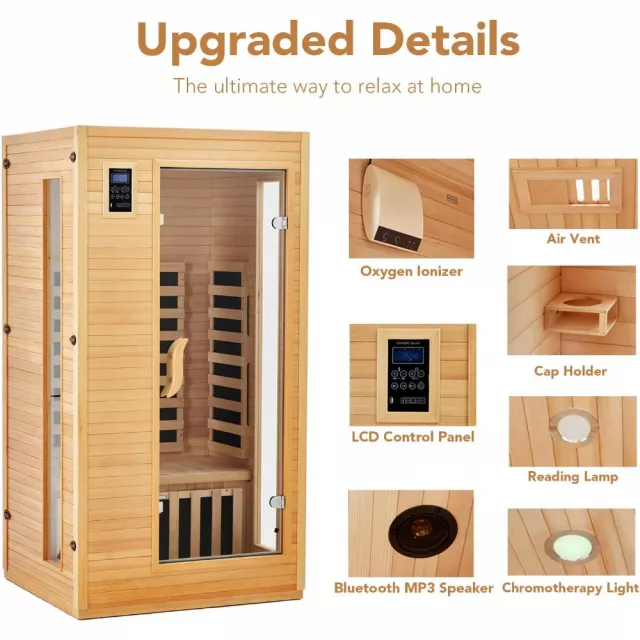
| Accessories (lights, audio, ionizers) |
Extra electronics can add noise and failure points |
Option to disable or omit nonessential components |
| Warranty and serviceability |
Heaters and controls are the most common service items |
Clear warranty terms and replacement-part availability |
Comfort, Safety, and Use Habits That Matter More Than Specs
How to Choose the Right Low-EMF 2-Person Infrared Sauna
For additional technical background on standards and safety concepts around electromagnetic measurements, the IEEE standards overview is a useful starting point.
FAQ
How is EMF usually measured inside an infrared sauna?
EMF is typically measured with handheld meters for ELF magnetic fields and electric fields, and the results can change significantly by distance from heaters, measurement height (bench vs. head level), and whether the sauna is actively heating at operating temperature. Meaningful reports specify the meter type, exact locations, and units for each value.
Does a low-EMF sauna still heat as well as other infrared saunas?
Yes—heating performance mainly depends on total wattage, insulation, air sealing, and panel placement rather than the “low-EMF” label. A well-engineered low-EMF design can still deliver strong, even heating if components and wiring are planned intelligently.
What can be done to reduce exposure further during a session?
Sitting a bit farther from heater panels, choosing the center of the bench when possible, and turning off nonessential electronics (like lights or audio) can reduce localized fields. After installation, verifying with a meter can help you identify the lowest-reading seating positions in your specific room setup.
Recommended for you








Leave a comment