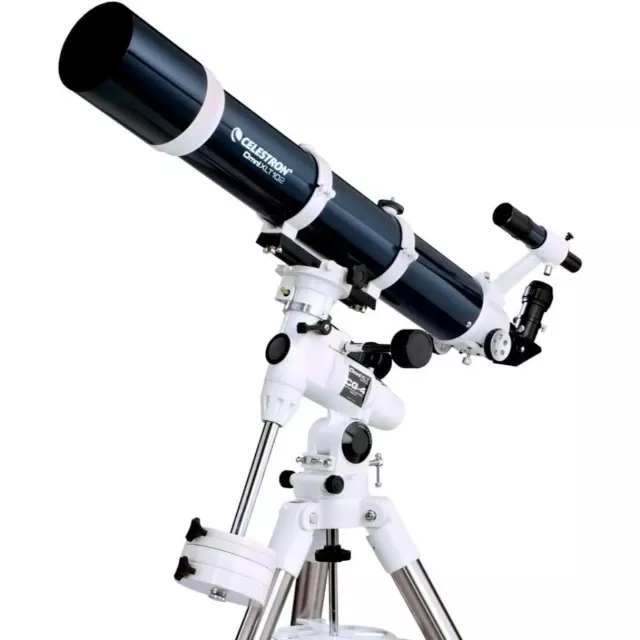
A hand-figured refractor paired with enhanced multi-coatings and a manual equatorial (EQ) mount is built for crisp contrast, dependable tracking, and a more hands-on observing style. The payoff shows up where it matters: cleaner star images, less glare on bright targets, and smoother motion when you’re following the Moon or a planet at higher magnification. Below is a practical guide to what these features do at the eyepiece, how an EQ mount changes the feel of observing, and how to match a refractor setup to the targets most people actually spend time on.
What Makes This Telescope Different at the Eyepiece
Refractors already have a reputation for sharp, “snappy” focus, and this configuration leans into that strength.
- Hand-figured optics: Hand figuring is intended to refine optical surfaces beyond basic mass-production tolerances. When the atmosphere cooperates, that can translate into tighter star points, a cleaner diffraction pattern, and a more confident best-focus point.
- XLT-style multi-coatings: Enhanced multi-coatings are engineered to boost light transmission and suppress reflections. In real observing, that typically means darker sky background around bright objects and fewer internal reflections when the Moon is in the field.
- Refractor practicality: A refractor’s sealed-ish optical train is generally low maintenance, holds collimation well, and avoids the frequent alignment checks that can come with some reflector designs.
Optical Performance: Hand-Figured Refractor + Enhanced Coatings
Contrast and scatter control
On bright targets, scatter control is often the difference between “I can sort of see it” and “there it is.” Good multi-coatings help reduce glare and ghosting, which is especially noticeable on the Moon’s sunlit rim, Jupiter’s cloud bands, and bright stars that can otherwise bloom or throw reflections across the field. For a deeper refresher on how telescopes deliver what you see at the eyepiece, Sky & Telescope’s overview is a solid reference: https://skyandtelescope.org/astronomy-equipment/telescope-basics/.
Color correction expectations
Not all refractors handle color the same way. Depending on the glass type and focal ratio, bright objects can show a thin violet fringe at higher power, especially when the target is low in the sky or the atmosphere is unsteady. Longer focal ratios tend to make color control easier, while shorter tubes often favor portability and wide-field viewing. The key is to set expectations: some nights you’ll push magnification comfortably; other nights, backing off a step produces a sharper, more pleasing view.
Real-world sharpness depends on the whole system
Even excellent optics can only work with what you give them. Accurate focus, stable mounting, and decent thermal behavior matter as much as the lens figure. On nights of mediocre seeing, you may notice the image “boiling” at high power—no coating or optical polish can fully beat atmospheric turbulence. NASA’s skywatching resources are helpful for planning sessions and understanding what to look for over the course of the year: https://science.nasa.gov/skywatching/.
Manual EQ Mount: How It Changes Observing
A manual EQ mount isn’t just a different tripod head—it changes how you interact with the sky.
- Tracking feels more “single-axis”: Once the polar axis is aimed near the celestial pole, an EQ mount can follow the sky’s motion primarily by turning one axis. With slow-motion controls, that makes it easier to keep a planet centered at higher power.
- Less intuitive at first, better at high power: Alt-az mounts move up/down and left/right, which feels natural immediately. EQ mounts move in right ascension/declination, which can feel odd early on, but the payoff is smoother, more continuous tracking once you get the hang of it.
- Simple and dependable: Manual operation keeps the system straightforward: no batteries required for basic use, no electronic alignment routine, and fewer failure points if you’re observing away from power.
Setup and First Night Checklist
Small setup habits make a big difference in how “premium” the telescope feels in use.
What It’s Best For
Key Specs and What They Mean
Quick Spec Guide (Fill with Listing Details)
| Item |
Where to Check |
Why It Matters |
| Aperture (mm) |
Product specifications |
Determines light-gathering and potential resolution |
| Focal length / f-ratio |
Product specifications |
Affects field of view, magnification range, and color correction tendencies |
| Optical coatings |
Product description/specs |
Improves transmission and reduces reflections for better contrast |
| Mount type |
Product title/specs |
Manual EQ enables smoother tracking after polar alignment |
| Tripod material |
Product specifications |
Stability and vibration control at higher powers |
| Focuser size/type |
Product specifications |
Compatibility with diagonals, eyepieces, and adapters |
| Included accessories |
In-the-box list |
Determines how complete the first-night experience will be |
How to Choose the Right Hand-Figured Refractor Setup
Accessories and Upgrades That Pair Well
Care, Storage, and Keeping Optics Performing
FAQ
Does a manual EQ mount help with tracking planets at high magnification?
Yes. After a basic polar alignment, an EQ mount can track the sky’s motion mainly along one axis using slow-motion controls, which feels smoother at high power. Tracking quality still depends on alignment accuracy, mount stability, and good balance.
What do enhanced multi-coatings change in real observing?
They typically increase light transmission and reduce internal reflections, which improves perceived contrast. This is most noticeable on bright targets like the Moon and Jupiter, where glare control helps fine detail stand out more cleanly.
How much magnification is practical on a refractor like this?
Practical magnification depends on aperture and, even more, on atmospheric seeing and mount steadiness. On steadier nights you can use higher power effectively, but on average nights a slightly lower magnification often looks sharper and more detailed.
Recommended for you












Leave a comment